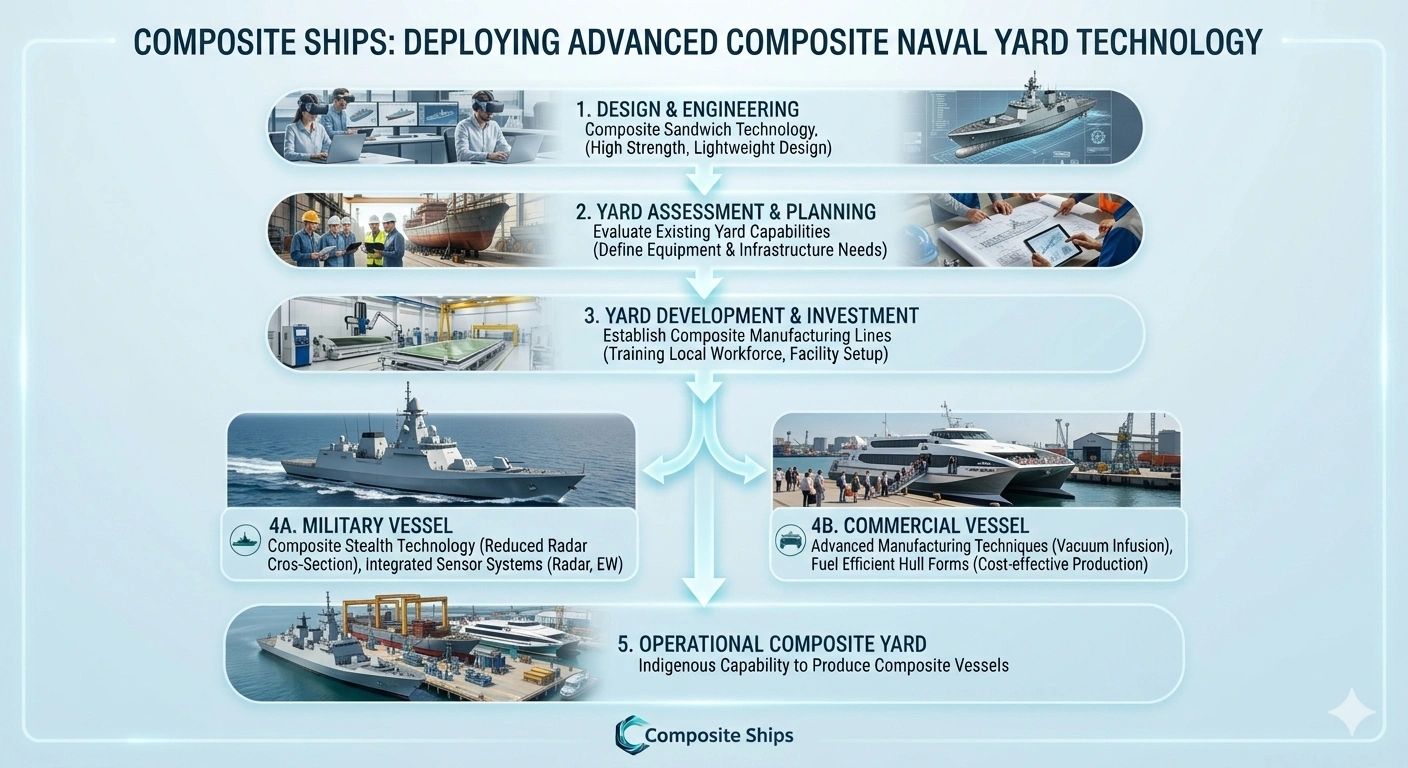
HOW COMPOSITE SHIPS WORKS WITH YOU:
To successfully partner with foreign governments to establish a local naval shipyard capable of fabricating advanced advanced composite vessels, you need a structured, multi-phase framework. This process navigates geopolitical, industrial, and technical challenges—such as technology transfer, local workforce training, and complex supply chain scaling. The step-by-step engagement process is detailed below.
Phase 1: Strategic Alignment & Sovereign Engagement
The goal of this phase is to establish political alignment and secure long-term government buy-in by anchoring the project to the host country’s national security or economic visions.
Align with National Directives: Pitch the shipyard as an enabler of the host nation's strategic goals, such as defense modernization, sovereign industrial capacity, or specific green maritime initiatives.
Formulate the Partnership Model: Structure the venture under a preferred local mechanism, such as a Public-Private Partnership (PPP), a joint venture with a state-owned defense entity, or via dedicated sovereign schemes.
Draft the Memorandum of Understanding (MOU): Secure a high-level MOU with the host nation's Ministry of Defense or Industry. This document should outline mutual funding commitments, tax incentives, land allocations, and guaranteed initial procurement pipelines (e.g., a "first 3 hulls" government contract).
Phase 2: Feasibility & Regulatory Structuring
Composite shipbuilding has distinct infrastructure and regulatory needs compared to traditional steel and aluminum fabrication.Site Selection & Logistics: Identify deep-water coastal access with adjacent land capable of supporting massive, climate-controlled fabrication facilities.
Regulatory & Classification Alignment:
Engage local maritime authorities and international classification societies (e.g., DNV, ABS, Lloyd's Register) early. Establish the design criteria for Fiber Reinforced Polymers (FRP) and carbon fiber structures based on the host nation's weight, passenger, or military survivability standards.Export Control & IP Compliance: If you are exporting proprietary tech, clear all export control regulations (such as ITAR for US-derived technologies or equivalent local defense trade controls).
Phase 3: Infrastructure Development (The "Digital & Clean" Yard)
Unlike traditional shipyards that rely heavily on heavy welding, foundry work, and outdoor dry docks, a composite shipyard operates more like an aerospace facility.
Infrastructure LayerRequirements & FeaturesClimate-Controlled Halls
Large-scale, clean-room environments to regulate temperature and humidity during resin infusion and vacuum bagging processes.
Curing InfrastructureLarge-scale industrial ovens or modular heating blankets to cure mega-sections of hulls.
Digital ManufacturingAI-enabled, automation-ready workflows utilizing a fully digital mockup. Workers utilize augmented reality (AR) and tablets to view 3D models and verify fiber layouts or piping placements.